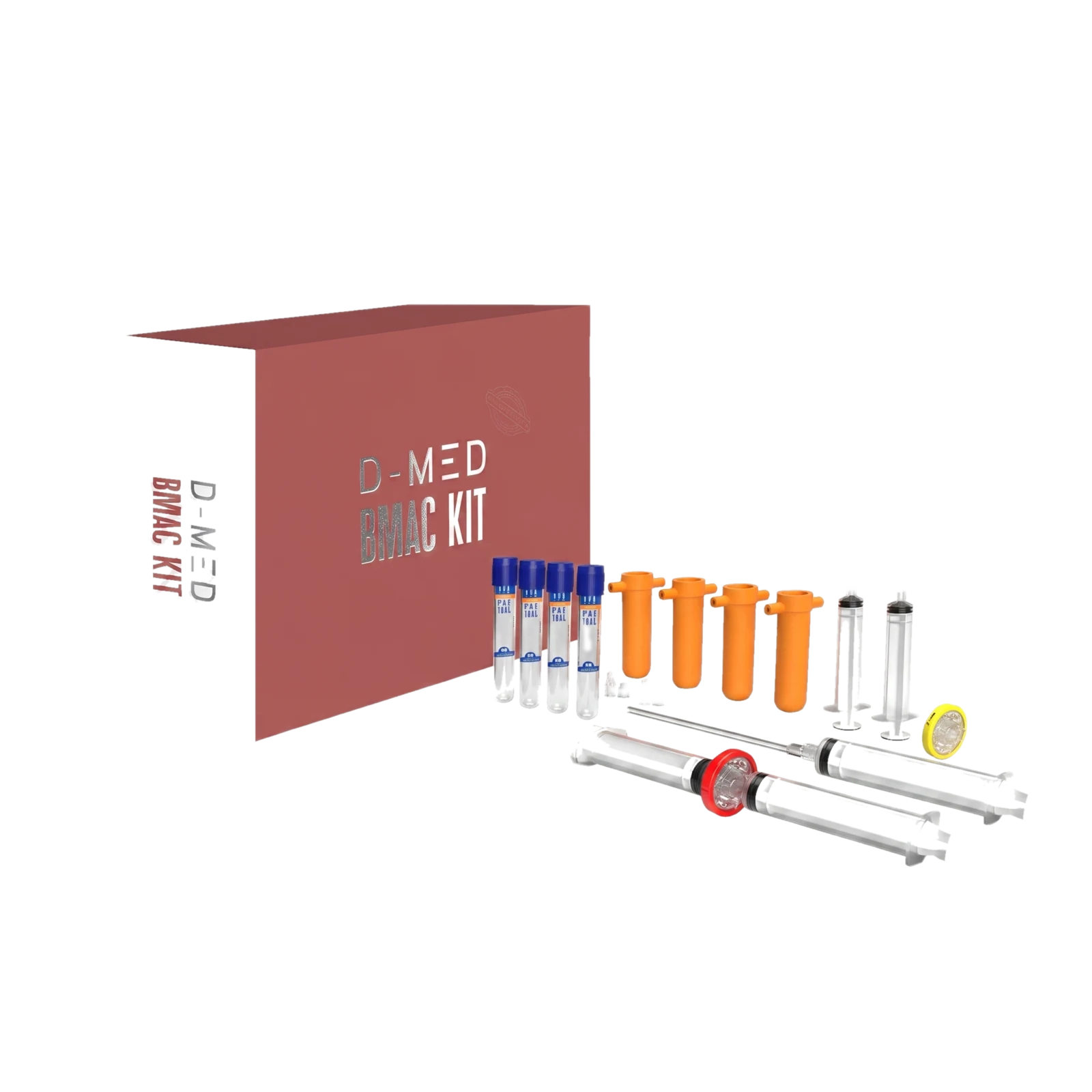

BMAC Kit

Bone marrow aspirate concentrate, with micro filtration.

What it treats

Applications

  • Orthopaedics.
  • Restoration of bone, cartilage, muscle, tendon and other connective tissue, the tissues D-MED names for the mesenchymal stem cells this kit harvests.
  • Repair of damaged tissue from the patient's own biological resources, the first principle D-MED names for regenerative medicine.
  • Osteoarthritis, chronic tendon disorders and diabetic wounds, among the chronic conditions D-MED names for regenerative medicine, the treatment family it files BMAC in.

The mechanism

How it works

Bone marrow clots fast once it leaves the body. D-MED states that megakaryocytes start building a fibrin network straight away, and that this fibrin traps mesenchymal stem cells inside the clot, where they can be neither collected nor injected. The kit answers that with two components D-MED names. The Cellitium blade, at 600 microns, delays that fibrin formation and breaks down the fibrin already built around the cells, which D-MED states widens the window for harvesting and keeps the suspension injectable. The aspirate then goes into a D-MED PRX Tube for centrifugation, and the cell-rich fraction is passed once through the Cellitium filter, at 150 microns, to take out the micro bone particles that aspiration scatters and that D-MED links to pain at the injection site. D-MED publishes the sequence in nine named steps, from preparation to that final filtration. That is the kit's mechanism. D-MED publishes no clinical indication for the kit itself, and every use listed above is attributed to D-MED in the bullet that carries it.

Cellitium blade

600 microns

Cellitium filter

150 microns

Filtration passes

One, on the final product

Centrifuge tube

D-MED PRX Tube, named at step 5 of the manufacturer's sequence

Published sequence

Nine named steps, preparation through to filtration

Coverage

Bone marrow aspiration through to injection

In the room

Why this system

Micro filtered concentrate

BMAC Kit concentrates bone marrow aspirate through micro filtration.

A blade that buys time on the aspirate

D-MED states its Cellitium blade technology delays the fibrin formation that would otherwise trap mesenchymal stem cells in the clot, which widens the window for harvesting them and keeps the suspension injectable.

A 150 micron filtration step, for a reason D-MED names

Aspiration scatters micro bone particles into the collected cells. D-MED states these can cause pain at the injection site, and passes the final product once through the Cellitium filter to take them out.

One kit from aspiration to injection

D-MED presents the BMAC Kit as the whole system ready for use, from bone marrow aspiration through to injection.

The detail

What to know

What does the BMAC Kit produce?

Bone marrow aspirate concentrate, through micro filtration.

Is the material autologous?

Yes. No product in this portfolio uses human donor material of any kind; every regenerative system here is autologous, plant-derived or synthetic.

What does the Cellitium blade do?

D-MED states the 600 micron blade breaks down the fibrin that megakaryocytes form around the aspirated cells, and delays that fibrin forming in the first place, so the cells can be collected and stay injectable.

What does the 150 micron filter take out?

Micro bone particles scattered by the aspiration. D-MED states these can cause pain at the injection site, and passes the final product through the filter once to remove them.

How many steps does D-MED publish for the procedure?

Nine, named in its own diagram: preparation, bone marrow access, aspiration, the 600 micron Cellitium, transfer to the PRX tube, centrifugation, post centrifugation, collection of the cell-rich fraction, and filtration through the 150 micron Cellitium.

DNA Nexus support

DNA Nexus supplies D-MED BMAC Kit as part of the D-MED regenerative range, with after-sales technical support from Cairo.

BMAC Kit - D-MED