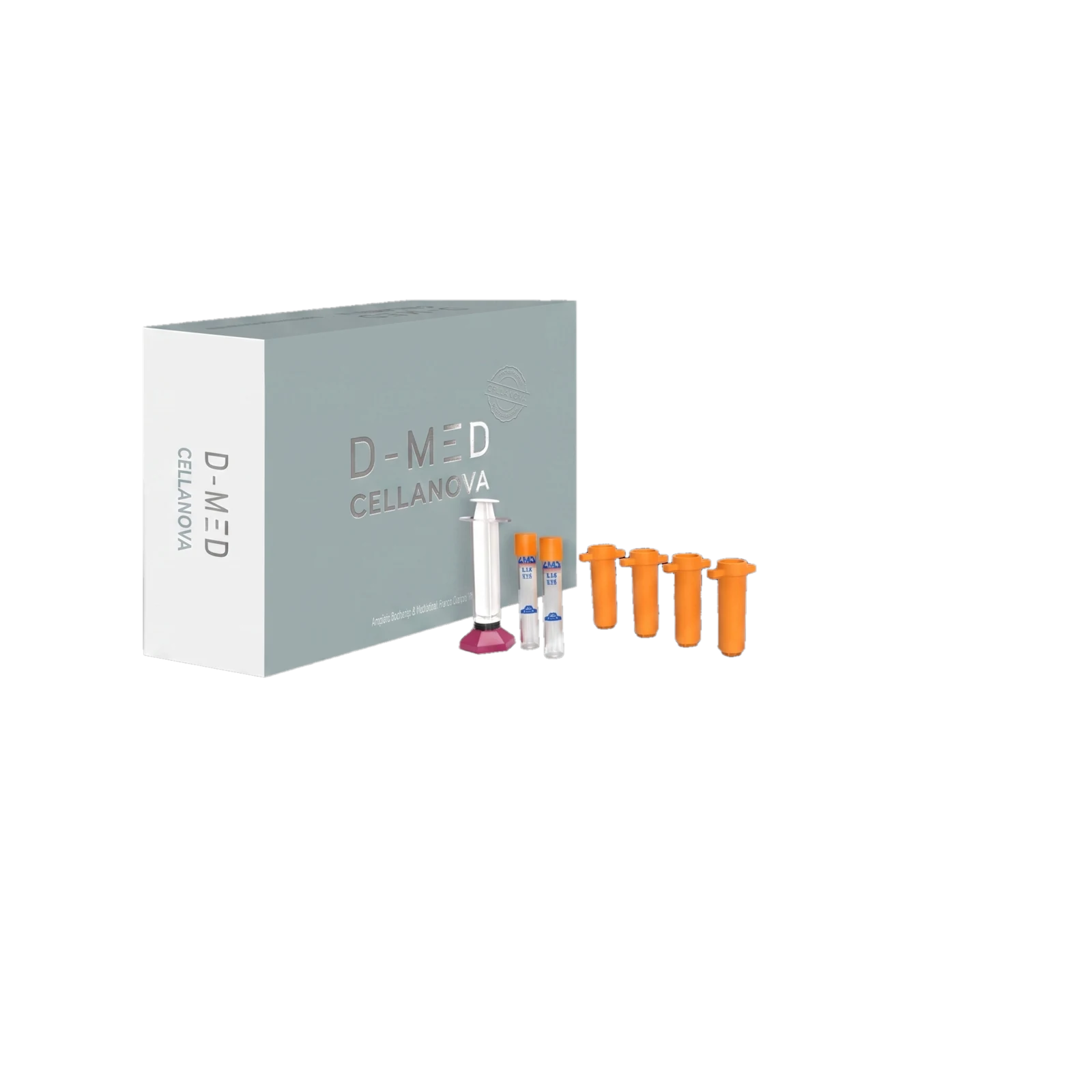

CELLANOVA SVF Kit
Non-enzymatic mechanical isolation of stromal vascular fraction from adipose tissue, through a 41 micron final filter, with no collagenase used.
Applications
Skin rejuvenation.
Orthopaedics.
Restoration of bone, cartilage, muscle, tendon and other connective tissue, the tissues D-MED names for the mesenchymal stem cells this kit isolates.
Repair of damaged tissue from the patient's own biological resources, the first principle D-MED names for regenerative medicine.
Osteoarthritis, chronic tendon disorders and diabetic wounds, among the chronic conditions D-MED names for regenerative medicine, the treatment family it files SVF in.

How it works
CELLANOVA isolates the stromal vascular fraction from adipose tissue mechanically, with no collagenase and no other enzyme. D-MED's published process starts from 60cc of lipoaspirate: the material is decanted to 40cc of fat, then condensed and purified down to 20cc, with triglycerides, red blood cells and white blood cells taken out. That step leaves 6 to 8cc of product rich in SVF cells, which then passes through a 41 micron filter; D-MED states this filtration helps provide a safer injectable cellular suspension. Fibrotic tissue, adipocytes and triglycerides stay out of the final product, and D-MED states the result can be viewed directly under a standard microscope, its nucleated and non-nucleated cells identified, counted and checked for viability under fluorescence. That is the kit's mechanism. D-MED publishes no clinical indication for the kit itself, and every use listed above is attributed to D-MED in the bullet that carries it.
Starting material
60cc of lipoaspirate
After decanting
40cc of fat
After condensing and purifying
20cc, triglycerides, red and white blood cells removed
Product rich in SVF cells
6 to 8cc
Final filter
41 microns
Filtered final product
6 to 8cc
Enzymes
None, and no collagenase
Viability of nucleated cells
92.8 percent, from a report on samples dated 28 December 2020
Why this system
Mechanical, not enzymatic
CELLANOVA isolates stromal vascular fraction from adipose tissue by mechanical means, with no collagenase used.
A 41 micron final filter
The final product passes through it before injection, and D-MED states that this filtration helps provide a safer injectable cellular suspension.
Cell isolation, with the fat left out
D-MED states SVF cells are isolated from the tissue's extracellular matrix, and that fibrotic tissue, adipocytes and triglycerides are kept out of the final product.
Cells that can be counted
D-MED states the final product can be viewed directly under a standard microscope, and that under fluorescence its nucleated and non-nucleated cells can be identified, counted and checked for viability.
What to know
Does CELLANOVA use collagenase?
No. Isolation is mechanical, with no collagenase used.
What does CELLANOVA filter to?
A 41 micron final filter.
Is the material used allogeneic?
No. No product in this portfolio uses human donor material of any kind; every regenerative system here is autologous, plant-derived or synthetic.
How much product comes out of the kit?
D-MED's process diagram starts from 60cc of lipoaspirate and ends with 6 to 8cc of filtered product rich in SVF cells.
Can the cell yield and viability be checked?
D-MED publishes a cell count report on samples dated 28 December 2020, run on the LunaSTEM system, recording 92.8 percent viability of nucleated cells, and a flow cytometry report run at Hacettepe University Teknokent on the same samples.
Does D-MED name a skin use for SVF?
On its own blog, D-MED names SVF based treatment among what can be combined with laser treatment to help the skin heal and look younger faster. That is a use D-MED names for SVF based treatment, not an indication it gives the kit.
DNA Nexus support
DNA Nexus supplies CELLANOVA SVF Kit as part of the D-MED regenerative range, with after-sales technical support from Cairo.
CELLANOVA SVF Kit - D-MED
