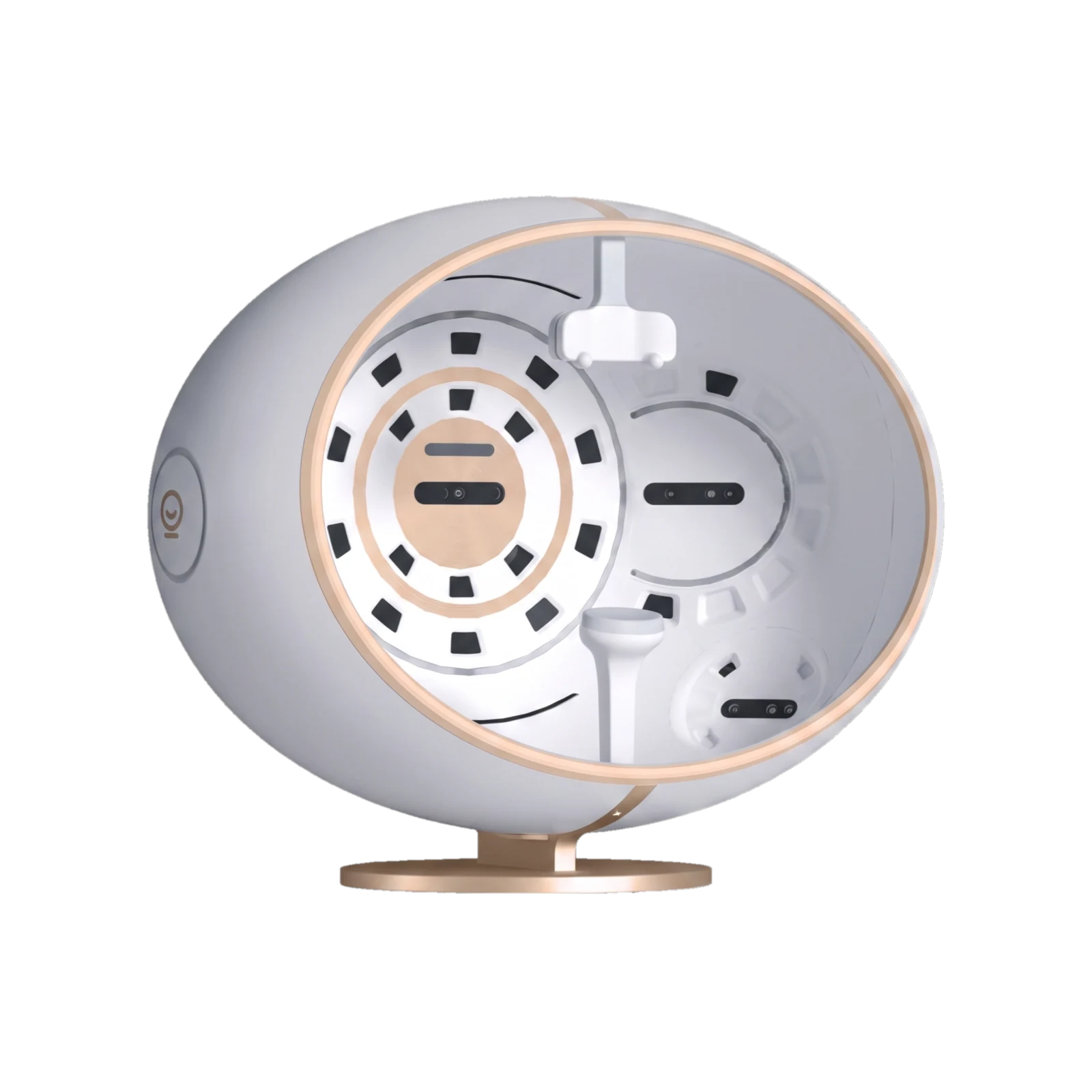

Eve Muse
A 3D facial imaging and treatment simulation system, built for consultation and treatment planning, not diagnosis.
Applications
Consultation and treatment planning for skin rejuvenation, through 3D facial imaging and simulation.
Skin analysis, to analyse more than 40 skin and aging concerns through 3D modeling, for AI-powered facial assessments.
Skin simulation, to show how skin conditions could improve or worsen under different scenarios, across the full face or specific skin dimensions.
Facial contour analysis, a planning aid for filler injections, lifting procedures and thread lifts, to enhance facial balance and definition.
Thermal map comparison, to compare 3D facial scans with colour-coded thermal layers captured at different time points and visualise skin surface changes.
Dynamic historic comparison, to display subtle 3D facial structure changes over time on a timeline slider, so users can compare multiple angles.

How it works
Eve Muse builds a three-dimensional model of the patient's face from five 16-megapixel cameras and five structured light sources (white RGB, UV, cross-polarized, parallel-polarized and Wood's), plus a dedicated 3D calibration source, calibrated dually against a 3D geometric board and a 24-colour card. An on-board multi-core AI processing unit then analyses more than 50 dimensions of facial proportion from that model, and the simulation modules use it to preview treatment outcomes such as filler volume.
Body materials
PC (polycarbonate), silicone and metal
Power adapter
100 to 240V AC input, 12V DC output, included
Calibration card
24-colour custom calibration card, ships with the unit
Calibration target
3D geometric calibration target, ships with the unit
Light shroud
Removable light-blocking shroud, ships with the unit
iPad screen
10 inches or larger, 1080p resolution or higher
iPad software
iPadOS 15 or later
iPad memory
4 GB RAM or higher, 64 GB storage or higher
Recommended iPads
iPad Air, 2020 models or later; iPad Pro, 2017 models or later
Why this system
A simulation toolkit, from filler heatmap to printed report
A 3D dynamic and volume heatmap for filler simulation, a golden ratio overlay, side-face preview, facial-third and contour-line analysis, side-face angle and E-line measurement, a timeline comparison across visits, and a branded printed report.
More than 50 dimensions of facial proportion
Computed from a scan taken by five 16-megapixel cameras and five structured light sources, plus a dedicated 3D calibration source. Facial proportion and skin condition are two separate counts on this device.
Installs on its own dedicated Wi-Fi network
The tablet is not supplied, and the system requires a dedicated 5GHz Wi-Fi network with dual-band steering disabled.
Anchored by dual calibration
The scan setup is checked against a 3D geometric calibration board and a 24-colour custom colour card, per the manufacturer's own specification.
What to know
Practice value
- Cameras: 5 x 16 MP high-resolution sensors
- Structured light sources: 5
- Light sources: White (RGB), UV, cross-polarized, parallel-polarized, Wood's, 3D calibration
- Calibration: Dual, 3D geometric board and 24-colour card
- Dimensions: 642 x 530 x 435 mm collapsed, 642 x 530 x 600 mm expanded
- Weight: 8.6 kg device, 17 kg packed
- Processor: Multi-core AI processing unit
- Storage: 128 GB
- RAM: 4 GB
- Power: 12V DC 5A, 60W max
- Connectivity: Dedicated 5GHz Wi-Fi, BLE 4.2, Type-C
Before installation. The tablet is not supplied, and the system requires a dedicated 5GHz Wi-Fi network with dual-band steering disabled.
Contraindications
Because of the magnets inside the device, Eve Muse should not be used on anyone with a pacemaker, retinal detachment, facial metal implants, or head or eye trauma sequelae.
What is Eve Muse built to do?
It is a 3D facial imaging and treatment simulation system, built for consultation and treatment planning, not for diagnosis.
Does Eve Muse come with a tablet?
No. It also requires a dedicated 5GHz Wi-Fi network with dual-band steering disabled.
Who should not be scanned with Eve Muse?
Anyone with a pacemaker, retinal detachment, facial metal implants, or head or eye trauma sequelae, because of the magnets inside the device.
How many cameras does Eve Muse use?
Five 16-megapixel cameras, with five structured light sources and a dedicated 3D calibration source.
Is Eve Muse a medical device?
No. Its device marks, SRRC, CCC, CE RoHS, CE RED and TELEC, cover radio and electrical compliance, not medical device certification.
Which iPad models does the manufacturer recommend for Eve Muse?
iPad Air, 2020 models or later, and iPad Pro, 2017 models or later.
What is Eve Muse made of?
PC (polycarbonate), silicone and metal, per the manufacturer's own materials specification.
When did EveLab Insight launch Eve Muse?
In 2025, per the manufacturer's own company history.
How does Eve Muse's Wood's Light mode help?
It visualises surface oil accumulation, localised dryness, and deep structural features.
DNA Nexus support
DNA Nexus will handle installation and set up Eve Muse on site, including the dedicated 5GHz Wi-Fi network it requires. After-sales technical support runs from Cairo.
Eve Muse - EveLab Insight
