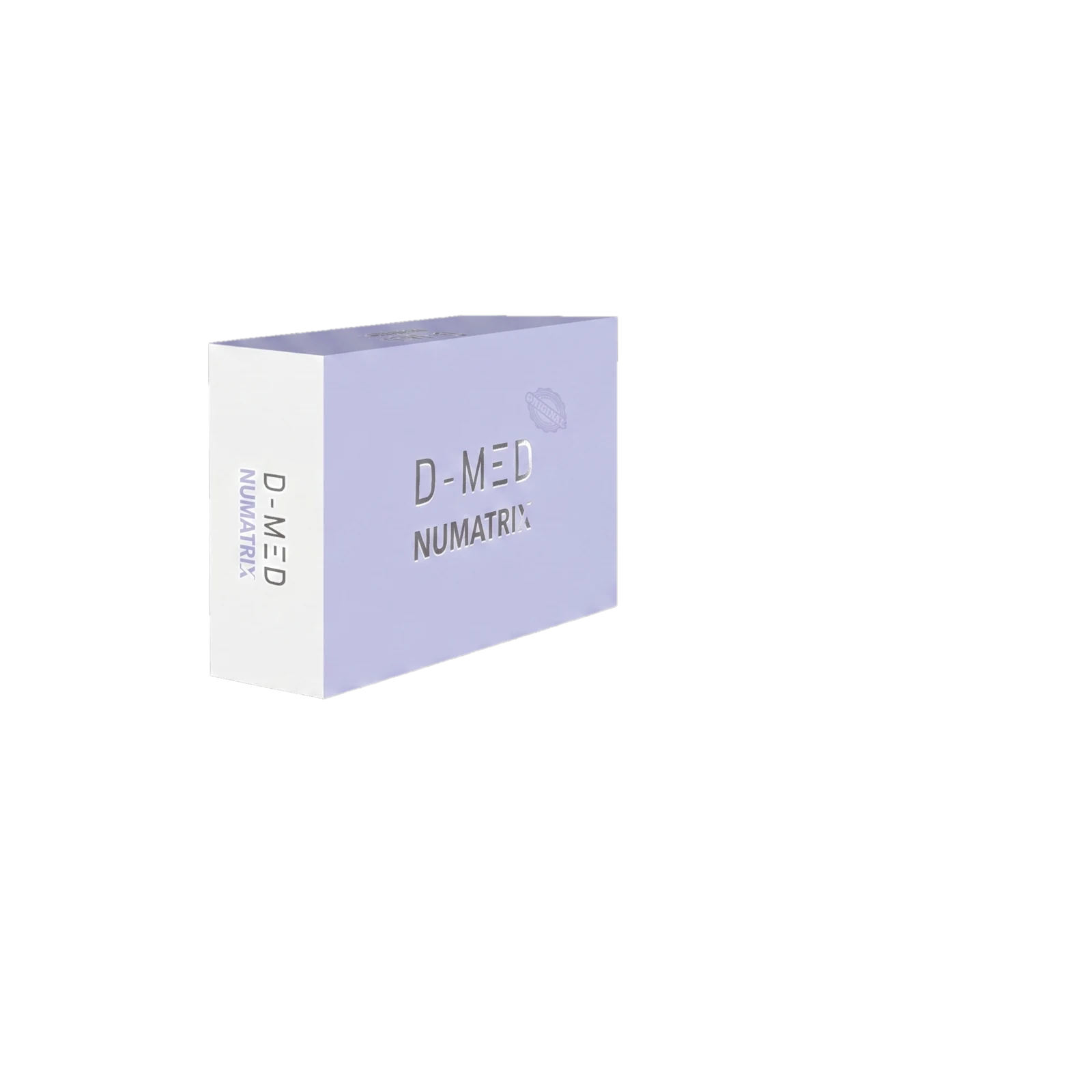

NUMATRIX Micrograft Kit
A micrografting kit built on D-MED's own Cellitium blades, no separate device required.
Applications
Skin rejuvenation.
Hair restoration.
Facial rejuvenation and skin renewal, a use D-MED names for the NUMATRIX kit.
Reduction of wrinkles and volume loss, another use D-MED names for the kit.
Enhancement of skin radiance and quality, another use D-MED names for the kit.
Patients undergoing or having undergone hair transplantation, a group D-MED names for the kit.

How it works
NUMATRIX is a device-free system: healthcare professionals run the entire procedure with the kit alone, without additional equipment. D-MED describes the Cellitium 600 micron blades, thousands of integrated micro-blades, as mechanically processing harvested tissue fragments to release cells from the tissue microenvironment for high cell yield and cell viability. In the protocol D-MED publishes, grafts are harvested from the sterilized area after local anesthesia, then mixed with saline solution or PRP, at the practitioner's preference, and passed through the Cellitium 600 micron blades 51 times; the resulting suspension is then passed once through the Cellitium 150 micron filter, which D-MED describes as filtering out unwanted fibrotic tissue fragments before injection.
Blade cycle
51 passes through the Cellitium 600 micron blades
Filter cycle
One pass through the Cellitium 150 micron filter
Protocol
Three published steps: harvest, 600 micron blade pass, 150 micron filter pass; no session-length figure is published beyond these steps
Blade size
Cellitium 600 micron
Filter size
Cellitium 150 micron
Why this system
Built on Cellitium blades
NUMATRIX uses D-MED's own Cellitium blade cartridges, at the 600 and 150 micron sizes.
No device required
D-MED states the whole procedure is performed with the NUMATRIX kit and no other equipment.
High cell yield and viability
D-MED describes the Cellitium 600 micron blades, thousands of integrated micro-blades, as mechanically processing harvested tissue fragments and releasing cells from the tissue microenvironment for high cell yield and cell viability.
A protocol published step by step
D-MED publishes the full protocol: grafts harvested after local anesthesia, passed 51 times through the Cellitium 600 micron blades, then once through the Cellitium 150 micron filter before injection.
What to know
Uses Cellitium blades
D-MED Cellitium Blade Cartridges has its own product page, with the full range of five blade sizes.
What blades does NUMATRIX use?
D-MED's own Cellitium cartridges, at 600 and 150 micron sizes.
Does NUMATRIX need a separate device?
No.
Can the grafts be mixed with PRP?
Yes. At the practitioner's preference, grafts are mixed with saline solution or PRP before the mixture is passed through the Cellitium 600 micron blades 51 times.
What does the pass through the Cellitium 150 micron filter do?
D-MED describes it as filtering out unwanted fibrotic tissue fragments from the cell suspension, for a safer injection.
DNA Nexus support
DNA Nexus supplies NUMATRIX Micrograft Kit as part of the D-MED regenerative range, with after-sales technical support from Cairo.
NUMATRIX Micrograft Kit - D-MED
