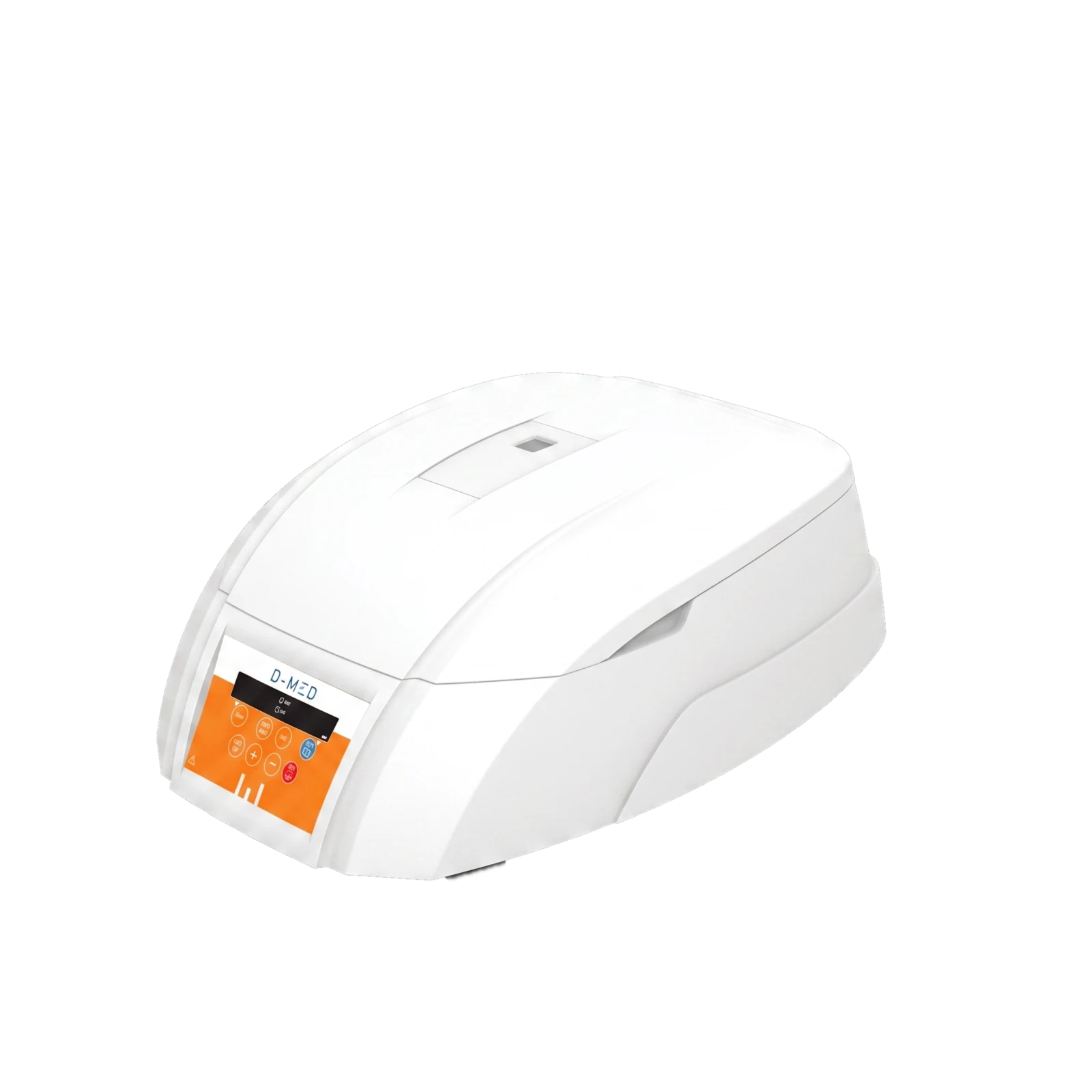

NXT S-106 Centrifuge
A swing rotor centrifuge running PRP, PRF and SVF protocols.
Applications
Runs the PRP (Platelet-Rich Plasma) protocol, one of three the manufacturer names for this machine.
Runs the PRF (Platelet-Rich Fibrin) protocol, another of the three.
Runs the SVF (Stromal Vascular Fraction) protocol, and the manufacturer states it is compatible with D-MED's own SVF protocol specifically.

How it works
The NXT S-106 spins on a swing rotor, which D-MED credits with significantly higher cell recovery efficiency. Acceleration and deceleration are controlled through the braking phase to limit concentration loss, which the manufacturer says gives higher reproducibility and precision. Smart ventilation and motor technology keep the sample under thermal control, which D-MED says prevents blood hemolysis, and the motor itself is a brushless design that the manufacturer says runs longer and needs no maintenance. The rotor stays balanced through the stop, so the separated layers do not remix once the spin ends.
Rotor capacity
6 x 10 ml buckets
Footprint
39.5 x 34.5 x 17.5 cm
Weight
8 kg
Maximum speed
4,000 RPM, stated by the manufacturer as 2,270 G
Speed adjustment
10 RPM increments
Programmable settings
99
Motor life
Brushless motor exceeds 10,000 hours of use; a common motor typically runs up to 3,000 hours, per the manufacturer
Read-out modes
RCF (G-force) or RPM, selectable
Display
Digital
Why this system
Three protocols, one centrifuge
PRP, PRF and SVF.
Controlled acceleration and deceleration
With smart ventilation, on a swing rotor.
Longer service life, lower running cost
D-MED states a service life four times longer than a standard centrifuge, which it frames as a cost-effectiveness argument.
A smaller footprint
Against typical swing-rotor centrifuges, D-MED states a footprint up to three times smaller, for less bench space and easier portability.
What to know
What protocols does the NXT S-106 run?
PRP, PRF and SVF.
What rotor does it use?
A swing rotor, with controlled acceleration and deceleration and smart ventilation.
Why does thermal control matter during PRP and SVF processing?
D-MED says keeping samples below body temperature matters in regenerative treatments such as PRP and SVF: temperatures above physiological levels may lead to hemolysis and reduced SVF cell viability, a risk that grows during repeated, high-volume centrifugation cycles in warm environments.
What safety features does the NXT S-106 have?
An imbalance-detection system and a lid-locking system that engages during a run.
DNA Nexus support
DNA Nexus will handle installation and set up the NXT S-106 Centrifuge on site.
NXT S-106 Centrifuge - D-MED
