
Applications
Skin rejuvenation.
Hair loss, including androgenetic alopecia, one of the uses D-MED names for the PRP therapy this syringe prepares.
Joint injuries and osteoarthritis, at the knee, hip and shoulder, one of the uses D-MED names for the PRP therapy this syringe prepares.
Tendon injuries, one of the uses D-MED names for the PRP therapy this syringe prepares.
Muscle strains, tears and traumatic muscle injuries, one of the uses D-MED names for the PRP therapy this syringe prepares.
Chronic wounds, diabetic wounds and poorly healing tissue, one of the uses D-MED names for the PRP therapy this syringe prepares.

How it works
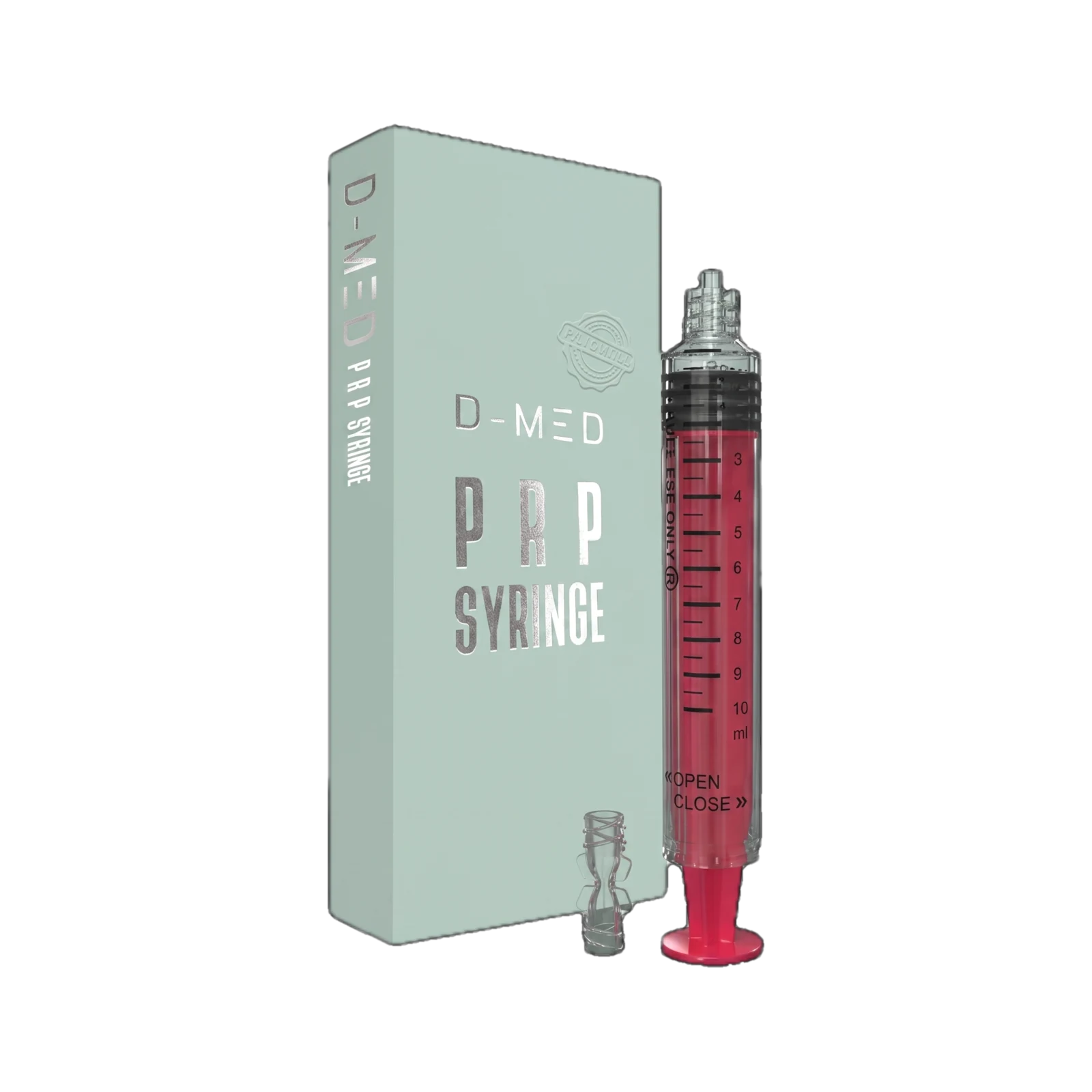
The PRP Syringe is one container doing two jobs. It arrives as a 10 mL syringe and takes the blood draw straight away, with nothing more than a needle or a butterfly set. Closing the cap and pulling the handle off turns that same body into a centrifuge tube, which D-MED states runs in any conventional centrifuge system, so the sample never moves from one container to another between the draw and the spin. After the spin, the plasma is transferred into a second syringe for injection. That is the whole of it: the syringe prepares and holds PRP, and D-MED publishes no clinical indication and no mechanism of action for the syringe itself. What it treats is what the PRP protocol it prepares treats, and every use listed above is attributed to D-MED in the bullet that carries it.
Volume
10 mL
Conversion
Two steps, syringe to centrifuge tube
Blood draw
Needle or butterfly set, no transfer step
Centrifuge
Any conventional centrifuge system
Protocols
All well known PRP protocols, I-PRF and A-PRF included
Platelet recovery rate
81.2 percent
Platelet dose
2.19 billion
Purity
97.7 percent
Where those three figures come from
An independent test conducted by Dr. Jeremy Magalon in 2020
Regulatory class
CE Class IIb, as published by D-MED
Why this system
Syringe and tube in one
A 10 mL syringe converts to a centrifuge tube in two steps.
Compatible with I-PRF and A-PRF
The syringe works with both protocols.
It spins in the centrifuge already in the room
D-MED states the converted tube works with all conventional centrifuge systems, so a clinic buys no second centrifuge to run it.
Its platelet figures come from an outside test
D-MED publishes a platelet recovery rate of 81.2 percent, a platelet dose of 2.19 billion and a purity of 97.7 percent, and attributes all three to an independent test conducted by Dr. Jeremy Magalon in 2020.
What to know
How does the PRP Syringe convert to a centrifuge tube?
In two steps. It ships as a 10 mL syringe and converts to a centrifuge tube.
Which protocols is the PRP Syringe compatible with?
I-PRF and A-PRF.
Does it need a particular centrifuge?
No. D-MED states the converted tube is compatible with all conventional centrifuge systems.
Where do the platelet figures come from?
D-MED publishes 81.2 percent platelet recovery, a 2.19 billion platelet dose and 97.7 percent purity, and attributes all three to an independent test conducted by Dr. Jeremy Magalon in 2020.
What regulatory class does the syringe carry?
CE Class IIb, published by D-MED on the product's own page.
Does D-MED name a skin use for the PRP therapy this syringe prepares?
Yes. On its own page about the PRP kit, D-MED names facial, neck and hand rejuvenation, skin tone irregularities and scar management. That is a use of the therapy, not an indication D-MED gives the syringe.
DNA Nexus support
DNA Nexus supplies D-MED PRP Syringe as part of the D-MED range, with after-sales technical support from Cairo.
PRP Syringe - D-MED

