
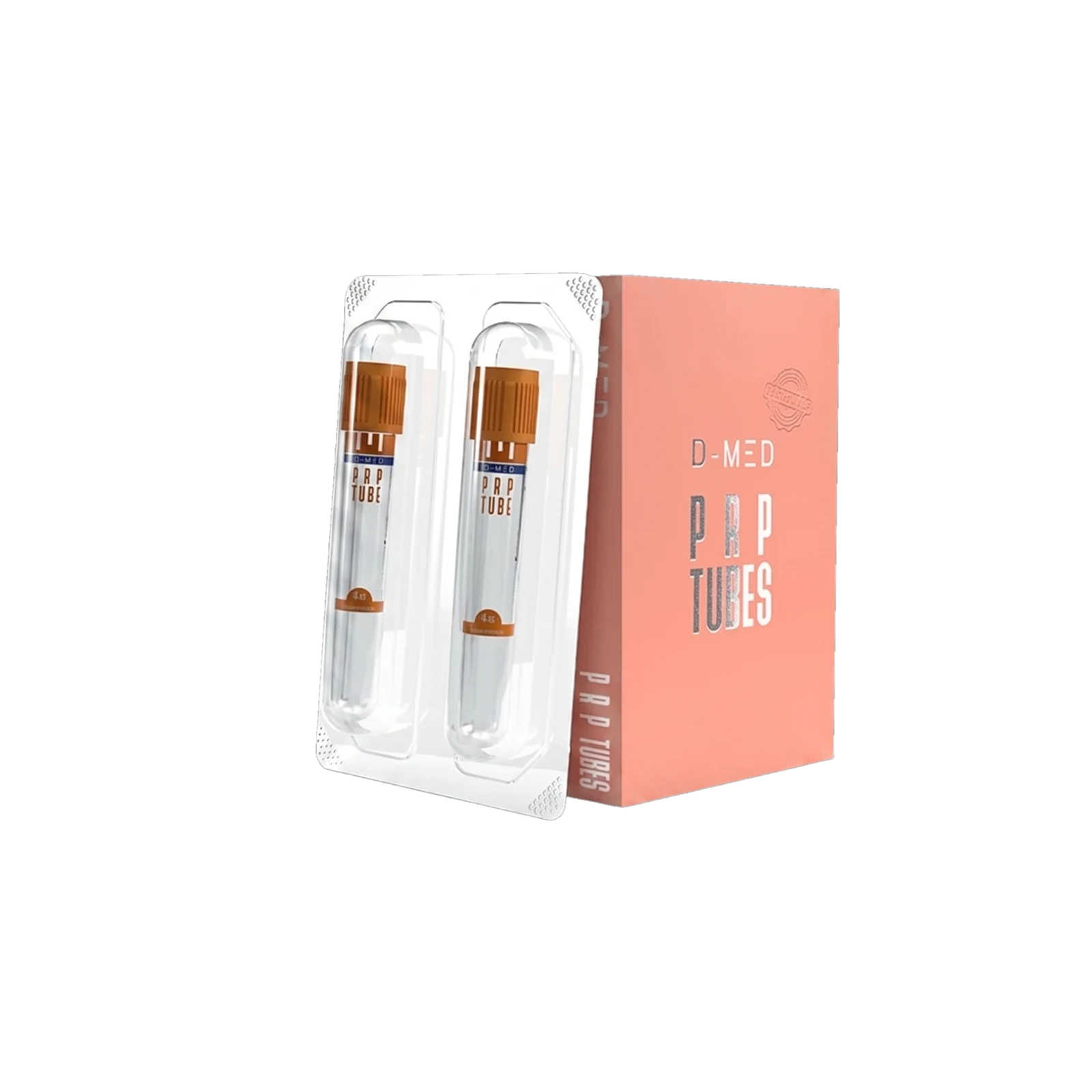

PRP Tubes
Blood collection tubes with micro polishing technology on the inner surface, built for D-MED's PRP protocols.
Applications
 Skin rejuvenation.
- Hair restoration.
- Dermatology, a medical specialty D-MED names among the fields where PRP Tubes are used.
How it works
D-MED finishes the inside of each tube with micro-polishing technology, producing a smooth, homogeneous inner surface. That finish reduces platelet adhesion to the tube wall and lowers mechanical losses during centrifugation and processing, which D-MED credits with a higher platelet recovery rate and PRP the manufacturer describes as more concentrated, stable and reproducible than standard tubes deliver. The tubes carry no separator gel: D-MED states gel can drag platelets beneath it during centrifugation and carries its own risk of allergic reaction, so the design removes it. D-MED positions PRP Tubes as a device built specifically for PRP extraction, not a general blood-storage or blood-separation tube: it is manufactured as a medical device and certified CE Class IIb.
Certification
CE Class IIb
Processing
Single centrifugation, closed-system design
Anticoagulant
Sterile sodium citrate, included in the tube
Separator gel
None; the tube is designed entirely without gel
Protocols supported
Amber PRP and Pure PRP
Platelet dose
4.3 billion, D-MED R&D Laboratories analysis
Purity
95.4%, D-MED R&D Laboratories analysis
Scientific literature
D-MED states the product's effectiveness is supported by 47 independent scientific publications
Why this system
A micro polished inner surface
D-MED finishes the tube's inner surface with micro polishing technology.
Single centrifugation, closed system
D-MED states the system requires only a single centrifugation process, and that its closed-system design minimizes the risk of contamination during processing.
Gel-free by design
D-MED states gel can drag platelets beneath it during centrifugation and carries its own risk of allergic reaction, so PRP Tubes are designed entirely without gel.
More than one hundred inspection stages
D-MED states PRP Tubes go through more than one hundred inspection and control stages, from raw material procurement through to final delivery to the patient, with testing, validation and documentation at every stage.
What to know
Built for the PRP Kit
The D-MED PRP Kit page names PRP Tubes as the tubes designed for its PRP preparation, and describes them as manufactured as medical devices under strict quality standards.
What is D-MED PRP Tubes' inner surface treatment?
Micro polishing technology, applied to the tube's inner surface.
Which D-MED kit are PRP Tubes built for?
D-MED's PRP Kit. That kit's own page describes PRP Tubes as specially designed for PRP preparation.
How many centrifugation steps does the PRP Tubes protocol need?
One. D-MED states the system requires only a single centrifugation process, with a closed-system design that minimizes the risk of contamination during processing.
What certification do D-MED PRP Tubes carry?
CE Class IIb. D-MED states the tubes are manufactured as medical devices specifically for PRP extraction, not as general blood-storage or blood-separation tubes.
Do the tubes contain separator gel?
No. D-MED states gel can drag platelets beneath it during centrifugation and carries its own risk of allergic reaction, so PRP Tubes are designed entirely without gel.
What is inside the tube?
A sterile sodium citrate anticoagulant, D-MED states, included so no separate anticoagulant needs to be added by hand.
Which PRP protocols do the tubes support?
Amber PRP and Pure PRP, D-MED states, so the clinician can choose the option suited to the treatment.

DNA Nexus support
DNA Nexus supplies D-MED PRP Tubes as part of the D-MED PRP range, with after-sales technical support from Cairo.
PRP Tubes - D-MED