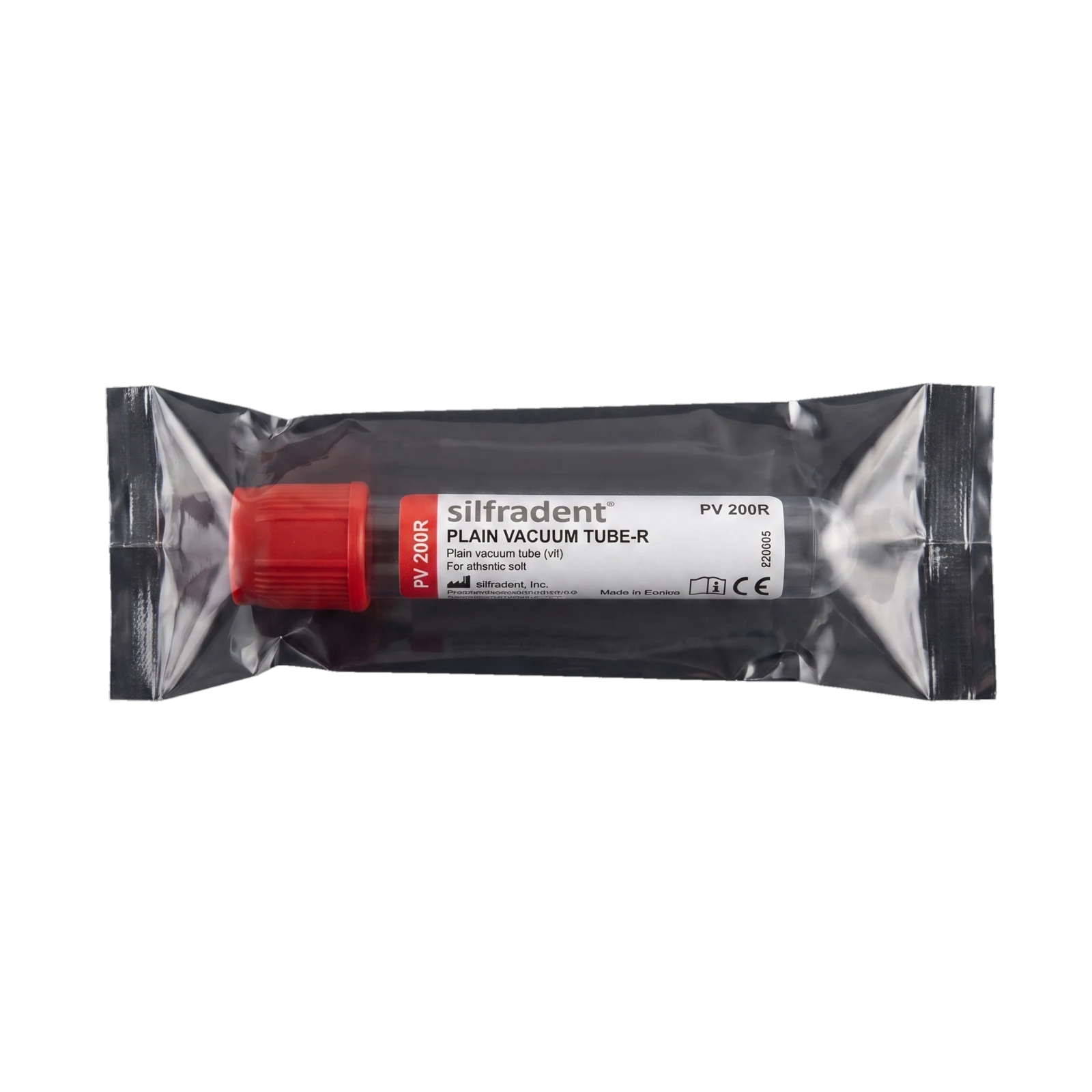

PV 200R Plain Vacuum Tubes

Plain vacuum tubes that yield Concentrated Growth Factors.

What it treats

Applications

  • Periodontology, implantology, maxillofacial surgery, cosmetic surgery, general surgery, wound care and ulcer care: the seven uses Silfradent names under Scope of use for the MEDIFUGE CGF system these tubes are drawn into and spun in.
  • Fibrin clots and blood components for those same seven fields: the Intended Use Silfradent writes into its own Instructions For Use for the kit these tubes belong to.
  • Maxillary sinus lift and profile ridge augmentation: the two procedures Silfradent names when it states where the efficacy of the CGF these tubes produce has been demonstrated so far.
  • Repair and regeneration of bone tissue, once the fibrin clot taken from these tubes is homogenised with autologous or synthetic bone in the ROUND UP: the use Silfradent names for that combination in its Instructions For Use.
  • Orthopedic surgery, oral surgery, ophthalmology, sport medicine, dermatology, gynecology and neurosurgery: seven further areas of use Silfradent names for the same system in its own MEDIFUGE and ROUND UP brochure.

The mechanism

How it works

PV 200R is a glass vacuum tube that carries nothing at all: Silfradent's own parts table calls it a glass vacuum tube without additives. The patient's blood is drawn straight into the 10 ml tube through the safety collection set, and the tube's own negative pressure does the filling, so the operator waits for the blood to stop entering rather than pulling it in. A filled tube is never shaken, and it goes into the MEDIFUGE CGF rotor within two minutes of the draw, always paired with another tube facing it across the rotor. One centrifugation, with nothing added to the sample, leaves three fractions in the tube: red cells at the bottom, platelet poor plasma at the top, and a fibrin clot between the two, which is lifted out and separated from the red fraction with scissors. Silfradent publishes the tube in one line as the plain empty glass tube that produces CGF solid plasma, and the fact that it holds no additive is what keeps the separation free of exogenous substances from the draw to the clot. Silfradent publishes no clinical indication for the tube itself and records no mechanism of action for it: the uses listed above are those of the MEDIFUGE CGF system and of the CGF protocol these tubes serve.

Volume

10 ml, ordered under a unitary code

Glass

Plain, no additive of any kind

Output

CGF, solid plasma

Pack

50 tubes, each packed singly in a double sterile bag

In the CGF K1 kit

100 tubes, listed against the code PV 200R

Tubes per run

Up to 8 in the MEDIFUGE CGF, always in opposite pairs

Tubes per patient

At least 4, Silfradent's own recommendation

From draw to rotor

Two minutes

CGF cycle on the MEDIFUGE CGF

5 minutes at 1,000 revolutions

Tube holders in the MEDIFUGE CGF

Teflon, sized for 10 ml tubes

Room temperature during separation

20 to 25 degrees Celsius

Sterility

Sterilised by the manufacturer, the method symbol printed on the pack

Expiry date

Printed on the packaging, checked before every use

Blood collection set

Safety set, G21 needle, for the Vacuette system

In the room

Why this product

Plain, no additive

A 10 mL glass tube with no separator gel or anticoagulant added, the collection tube Silfradent's own specification pairs with a CGF output.

Individually sterile bagged

Each tube in the 50-tube pack is double sterile bagged on its own.

Only the tubes Silfradent names

The manufacturer's own Instructions For Use tell the operator to use only the test tubes Silfradent recommends, and the guarantee repeats the rule for every accessory: replacement parts must be supplied or recommended by Silfradent.

A hundred of them arrive with the CGF K1 kit

The consumables table of those same Instructions For Use lists 100 units of PV 200R against the kit, so a clinic that buys the kit does not start from an empty shelf.

The detail

What to know

Practice value

  • Volume: 10 mL glass, plain
  • Output: CGF
  • Pack: 50, each individually double sterile bagged

Silfradent's own PV 200R and PV 200P vacuum tubes supply the collection side: PV 200R yields CGF, PV 200P yields liquid plasma PRP.

What does PV 200R produce?

CGF, Concentrated Growth Factors, from a plain 10 mL glass tube.

How is PV 200R packaged?

50 tubes to a pack, each individually double sterile bagged.

What is the difference between PV 200R and PV 200P?

PV 200R is a plain tube that yields CGF. PV 200P adds a separator gel and sodium citrate and yields liquid plasma PRP instead.

How many tubes go into the centrifuge at once?

Up to eight, and always in opposite pairs. Silfradent asks for a symmetrical load, each tube counterbalanced by another of the same weight, and the tubes go in within two minutes of the blood being drawn.

How many tubes should be prepared for one patient?

Silfradent recommends preparing at least four.

Can a tube be filled once it is in the rotor?

No. Silfradent's Instructions For Use say never to fill a tube while it sits in the rotor, and never to shake a filled tube before it goes into the centrifuge.

What temperature does the room have to be?

Between 20 and 25 degrees Celsius, because Silfradent requires the separation that produces CGF to take place inside that range.

Does the tube carry a class or a marking of its own?

Silfradent publishes a Class IIa and a CE marking for the MEDIFUGE CGF centrifuge these tubes are spun in. It publishes neither for the tube, and none is claimed for it here.

What should be checked before a tube is opened, and what happens to it afterwards?

The expiry date printed on the packaging and the integrity of that packaging, each time before use. A used tube is hazardous medical waste, not general waste.

DNA Nexus support

DNA Nexus will handle reorders of PV 200R alongside the rest of the Silfradent consumables line. After-sales contact runs from Cairo, alongside the rest of the DNA Nexus Silfradent range.

PV 200R Plain Vacuum Tubes - Silfradent